2
Kisspeptin pulses and desensitization
An early hormone rise can be followed by a very different response. The interval between observations changes the story.
An evoked LH pulse
A pulse has a place in time. In a study of thirteen healthy adult men, an intravenous kisspeptin-10 bolus induced an immediate LH pulse regardless of when the preceding endogenous pulse had occurred. The investigators described a resetting of the hypothalamic GnRH clock; the evoked pulse reflected roughly 17 minutes of sustained GnRH release. GnRH is the hormone signal that prompts LH release in this account.
The care paid to the preceding event is what makes this experiment satisfying to me. A hormone concentration alone would leave out that temporal relationship. The paper gives a signal a position in an ongoing rhythm, which is a more demanding and more interesting description than simply saying that LH went up.
The repeated-exposure experiment
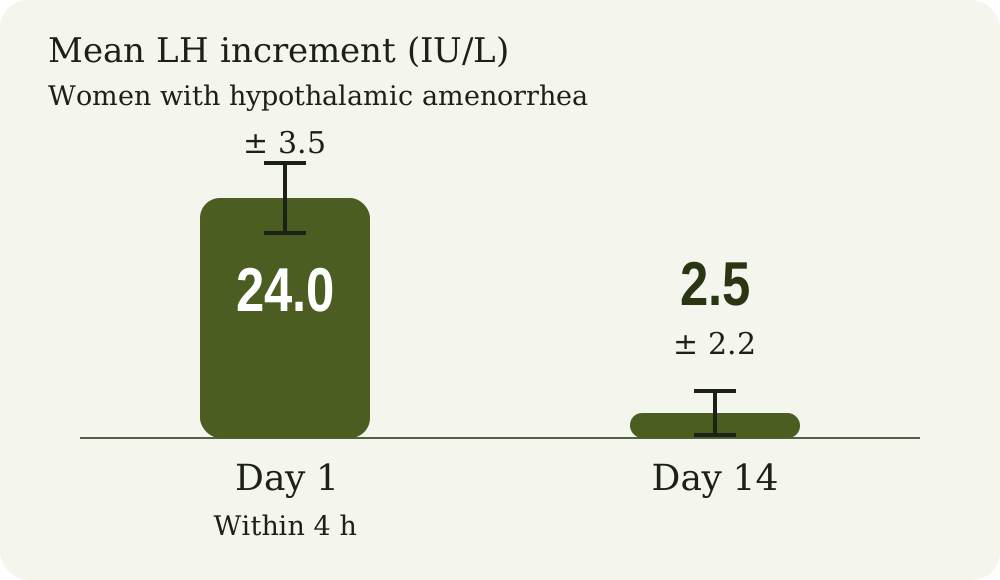
The response changed dramatically in the repeated-administration study in women with hypothalamic amenorrhea. On day 1, the mean LH increment was 24.0 +/- 3.5 IU/L within 4 h. With repeated subcutaneous kisspeptin-54 administration for 14 days, the day-14 response fell to 2.5 +/- 2.2 IU/L. These are reported study measurements in that population.
The name for the fading response is tachyphylaxis. The first result had been robust; the later result was markedly smaller. I regard the pairing as essential to understanding this experiment. Ending the account after the acute response would remove precisely the behaviour that makes the work consequential.
Infusion in hypothalamic amenorrhea
Another experiment examined continuous intravenous kisspeptin-54 in five women with hypothalamic amenorrhea. LH pulses rose from 1.6 to 5.0 per 8 h versus vehicle, while the highest infusion rate produced tachyphylaxis during the infusion. The finding contains both restored pulsatility and diminished responsiveness at the highest exposure.
Any description of kisspeptin as a simple volume control now strikes me as inadequate. The observed rhythm and the fading response put constraints on that metaphor. The experiment gives no basis for turning a stronger exposure into a general rule about a better outcome.
Receptor behaviour
A review of KISS1R pharmacology describes desensitization, receptor internalization and recycling as factors governing sustained or attenuated signaling. It offers a biological account of why brief and continuous receptor stimulation can produce opposing effects on the reproductive hormone cascade.
That account made me abandon the assumption that duration merely extends an acute effect. Duration can change the response itself. The reproductive application that most interests me therefore asks a fairly specific question: can a signal help produce a useful, timed event? The IVF trial takes that question into egg maturation.